

THANK YOU FOR SUBSCRIBING

 Torsten Welte, Global Vice President and Head of Aerospace and Defense, Industry Business Unit
In short, today’s customers expect industrial manufacturers to behave less like traditional manufacturers and more like service-focused, sustainability-minded partners whose business is as much about delivering positive outcomes as it is about providing products. To meet those expectations, even some of the world’s most seasoned manufacturers are embracing a concept called servitization, where a product— a piece of industrial machinery or office equipment, perhaps, or even a commodity like air or water — is bundled with complementary services, software, parts and/or consumables to create a solution or outcome that adds value for the customer. The customer benefits by swapping a large capital expenditure for a recurring operational cost, along with risk-sharing with the manufacturer, while the manufacturer diversifies with a consistent “as a service” revenue stream (XaaS, essentially “anything and everything as a service”)that, according toresearch by BCG, can yield 25 times more value over the lifetime of a customer.
As companies like Grunfos, the world’s largest pump manufacturer, are demonstrating, servitization isn’t just about the bottom line, it also enables a manufacturer to hone their focus (and their customers’ focus) on sustainability. The 75-year-old Danish company is delivering water-as-a-service, packaging the commodity with data-driven services (condition monitoring, predictive maintenance, etc.) that leverage the company’s intelligent, IoT-connected equipment.
Expect demand for XaaS solutions to persist long after the pandemic has subsided, because in the manufacturing sector, it’s now clear that servitization goes hand in hand with customer goals, such as digitalization, sustainability, and, ultimately, profitability.
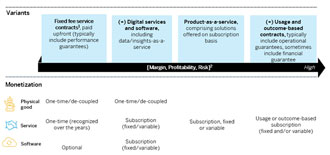
The possibilities for pursuing XaaS solutions are numerous. As Dr. Melchiore Bryant, a partner at Bain & Company, explained in a recent webinar (and as described in the graphic above), the options range from basic installation and maintenance contracts and digitalization of the service journey to solutions that bundle equipment with utilization data, predictive maintenance and deep analytics for benchmarking and plant optimization.
These kinds of solutions play right into the growing emphasis that many customers — as well as customers’ customers, shareholders, regulators, etc. — are putting on sustainability. Take, for example, Holland’s Philips, which sells lighting as a service to customers like Schiphol Airport in the Netherlands. The bulb manufacturer manages the airport’s lighting with an Internet of Things-based system, reducing Schiphol’s annual electricity consumption by 50 percent.
What’s more, because XaaS requires industrial manufacturers to assume responsibility for delivering an outcome, and in some cases for managing parts and equipment end-of-life, as well as other waste produced as a result. There’s additional incentive for industrial manufacturers to pursue a more sustainable, often modular, product design. Also, as they are involved in managing the entire product lifecycle, it makes sense to focus on a circular approach (embodied in the emerging Circular Economy), whereby materials, products or waste are recycled or repurposed, then returned to the value chain for reuse. Opportunities for industrial manufacturers to find markets for those products and materials are beginning to expand along with the Circular Economy.
The XaaS Spectrum
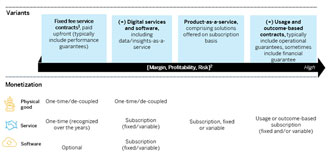
1 may include digital services and software
2 illustrative gradient for different business model scenarios.
How, then, to identify the right XaaS pathway(s) for your company, then turn it into a viable venture? Here are five critical capabilities and approaches that are translating into servitization success:
• A fundamental mindset shift.
Succeeding with XaaS requires a mindset shift across the entire business — in sales, product development, business operations, risk management and more. It’s all about focusing on the customer. Because XaaS solutions entail more risk-sharing between manufacturer and customer, the manufacturer has an opportunity to become more of a trusted partner, leading to deeper customer relationships that can produce additional cross-selling and upselling opportunities.
• Connected products.
Digital, networkable, sensor-equipped products provide the core for service-based solutions. With analytics and planning tools that are connected to those products in the field, manufacturers can extract insights from the operational data supplier by the equipment and combine it with additional customer data and environmental data, to package and forecast that insight as a value-added service.
• A flexible IT infrastructure.
Piloting, launching and integrating XaaS solutions into the business requires a robust but flexible digital core. Manufacturers may offer multiple XaaS solutions and business models, so they need the ability to combine real-time internal and external data across the entire value chain to effectively manage risk.
• A strong business network.
The success of a solution-based offering may well depend on close collaboration and communication among the manufacturer, its partners, suppliers and customers. This network or ecosystem provides a platform for sharing real-time insight and information, resolving issues and co-innovating to design and produce equipment built for today’s sustainably-minded world.
With such an ecosystem in place, supported by the right combination of Industry 4.0 capabilities and approaches, manufacturers have all the elements to satisfy their customers’ growing appetitefor outcome-based, sustainability-focused services that help them navigate an uncertain post-pandemic business landscape.

Company
SAP
Management
Torsten Welte, Global Vice President and Head of Aerospace and Defense, Industry Business Unit
Description


Manufacturing Technology Insights Weekly Brief
Be first to read the latest tech news, Industry Leader's Insights, and CIO interviews of medium and large enterprises exclusively from Manufacturing Technology Insights
